Artificial intelligence is no longer just a futuristic concept. In 2026, AI is becoming part of everyday life, helping people study, work, create content, and solve problems.
But how many Americans actually use artificial intelligence? And is AI really as popular as the headlines suggest?
Recent research from Pew Research Center, Gallup, and Stanford University reveals some fascinating trends.
1. Nearly Half of Americans Use AI Chatbots
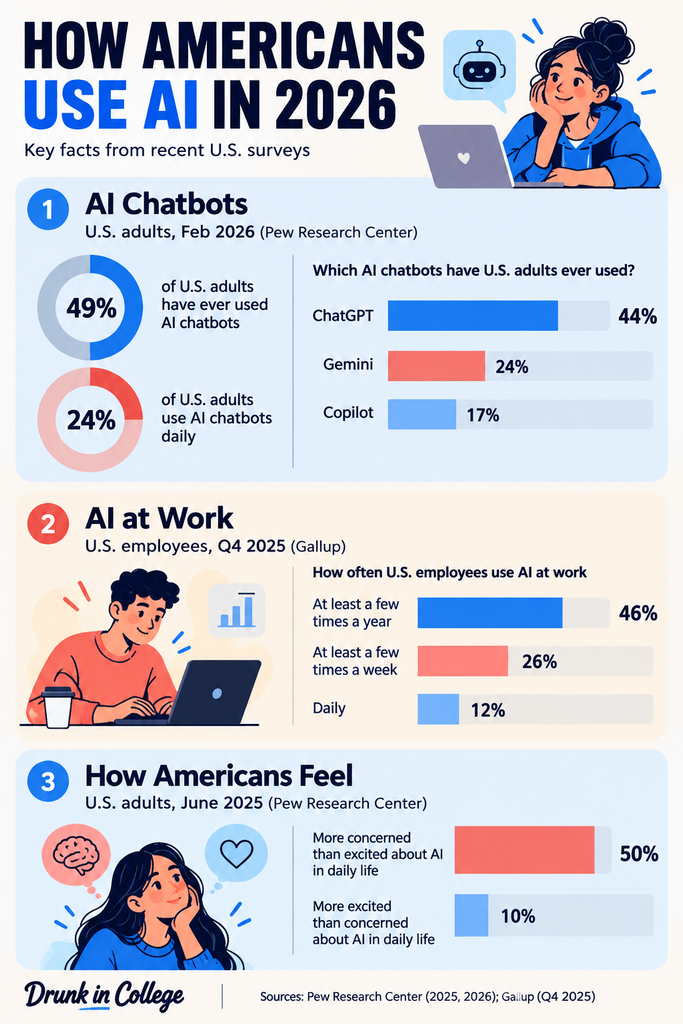
According to a February 2026 Pew Research Center survey, 49% of U.S. adults have used AI chatbots such as ChatGPT, Gemini, or Copilot.
That’s a significant increase from 33% in 2024.
Even more interesting, 24% of American adults now use AI chatbots daily.
This suggests that AI is becoming a regular digital tool rather than something people try once out of curiosity.
2. ChatGPT Leads the AI Chatbot Market
ChatGPT remains one of the most recognizable AI platforms in the United States.
Pew Research Center found that 44% of American adults have used ChatGPT, compared with 24% who have used Google’s Gemini and 17% who have used Microsoft Copilot.
These figures measure whether respondents have ever used each service, not market share or exclusive usage.
People can use multiple AI platforms depending on their needs, from brainstorming ideas to writing emails and researching unfamiliar topics.
3. AI Is Changing the Workplace
Artificial intelligence is also becoming increasingly common at work.
Gallup reported that 46% of U.S. employees used AI in their jobs at least a few times per year during the fourth quarter of 2025.
Meanwhile, 26% used AI frequently, meaning at least a few times per week, and 12% used it daily.
However, adoption varies considerably between industries and job types.
Employees in remote-capable positions are more likely to use AI than workers whose jobs require physical presence.
4. Students Are Embracing Generative AI
College campuses are another important part of the AI revolution.
Stanford University’s 2026 AI Index Report highlights widespread generative AI adoption among university students, reporting that approximately four in five students use the technology.
Students may use AI tools to explain difficult concepts, organize study notes, practice languages, or brainstorm project ideas.
However, universities continue to face questions about academic integrity, accuracy, and appropriate AI assistance.
AI can support learning, but students still need to verify information and develop independent thinking skills.
5. Americans Still Have Concerns About AI
Growing adoption doesn’t mean everyone trusts artificial intelligence.
A 2025 Pew Research Center survey found that 50% of U.S. adults were more concerned than excited about AI’s increasing role in daily life.
Only 10% were more excited than concerned.
Concerns include misinformation, privacy, employment changes, and the possibility of becoming overly dependent on automated tools.
What Does the Future Hold?
AI usage is growing, but adoption and enthusiasm are not the same thing.
Millions of Americans are experimenting with AI, while others remain cautious about its effects.
For students, workers, and everyday internet users, the challenge is learning how to benefit from AI without relying on it blindly.
One thing is clear: artificial intelligence is already changing how Americans learn, work, and interact with technology.